

Can You Really Leave Your Bag Unattended in Korea? If you walk into a busy cafe in Seoul, you’ll notice something that might seem terrifying at first: expensive laptops, iPhones, and designer wallets sitting on tables while their owners are nowhere to be found. In most parts of the world, this is an open invitation for theft. But in South Korea, it’s just a typical Tuesday.
Many travelers arrive in Korea with a healthy dose of skepticism. Can a country truly be this safe? The answer lies in a unique blend of high-tech surveillance, deep-rooted social values, and a systemic honesty that often feels like magic to outsiders. In this guide, we’ll explore the fascinating “Lost and Found” culture in Korea and what to do if you actually lose something.
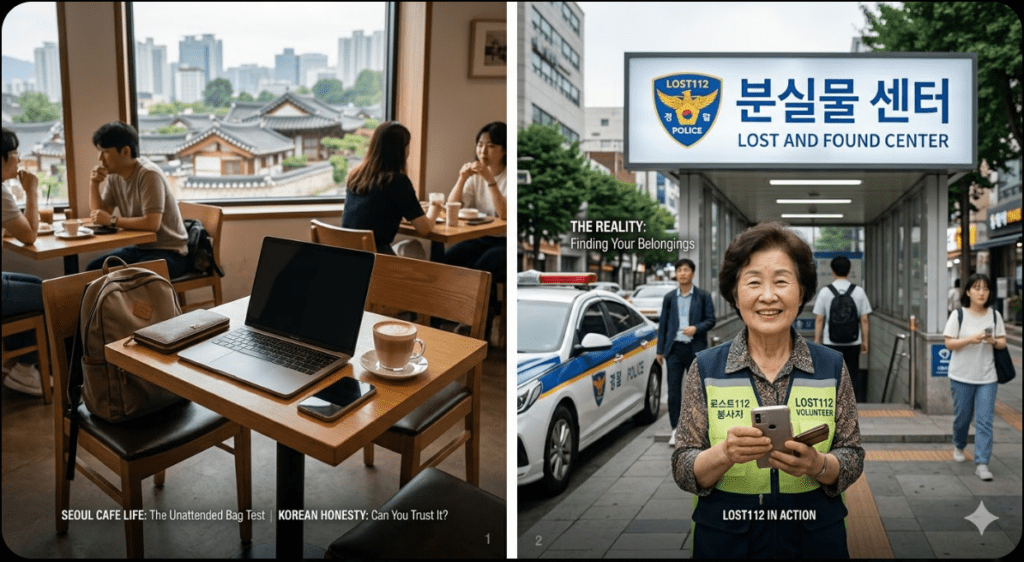
1. Why South Korea is a Haven for Your Belongings
It’s not that crime doesn’t exist in Korea, but the social cost of stealing is incredibly high. There are three main pillars that support this culture of honesty.
The Power of “Yang-sim” (Conscience)
In Korea, there is a strong emphasis on “Yang-sim” (양심), which translates to conscience or integrity. From a young age, Koreans are taught that taking something that doesn’t belong to you brings shame, not just to yourself but to your family. This collective moral compass is a primary reason why people will often go out of their way to return a dropped wallet.
24/7 Surveillance: The Eye in the Sky
South Korea has one of the highest densities of CCTV cameras in the world. Whether you are in a subway station, a convenience store, or a tiny alleyway, you are likely on camera. This acts as a powerful deterrent. Potential thieves know that if they pick up a phone that isn’t theirs, their entire path can be tracked by the police within minutes.
A Digitalized Social Credit System
While not an official “score,” Korea’s highly digitized society means almost every transaction is linked to an identity. If someone uses a lost credit card, they are caught instantly. This transparency creates an environment where honesty is the most logical path.
2. Real-Life Magic: My Personal Experience
To give you an idea of how this works, let me share a quick story. Last year, I accidentally left my iPad on a green bus (Maeul Bus) in Seoul. I realized it two hours later. In many cities, that iPad would be gone forever.
I went to the final bus stop, and the driver simply pointed to a shelf behind his seat. There it was, untouched. A student had found it, handed it to the driver, and continued their day. This isn’t an anomaly; it’s the standard.
Safety Comparison: Korea vs. The World
| Feature | South Korea | Most Global Cities |
|---|---|---|
| Leaving a bag in a cafe | Common & Generally Safe | High Risk of Theft |
| Lost Wallet Return Rate | Very High | Moderate to Low |
| CCTV Coverage | Extremely Dense | Varies by District |
| Public Trust Level | High (Social Cohesion) | Low to Moderate |
3. What to Do If You Lose Something in Korea
Even in a safe country, mistakes happen. If you lose an item, don’t panic. There is a very high chance you will get it back if you follow these steps.
Step 1: Visit the LOST112 Portal
The Korean National Police Agency’s Lost and Found Center (LOST112) is a centralized database where almost all found items are registered. You can search by category, date, and location. If you’ve lost something, checking this site should be your first move.
Step 2: Check Public Transport Centers
If you left something on the subway or a bus, each line has its own dedicated lost and found office.
- Subway: Items are usually kept at the station where they were found for a few days before being sent to a central depot.
- Taxis: If you paid by credit card or used a Kakao Taxi app, you can easily track the driver’s contact information.
Step 3: Useful Korean Phrases for Help
If you need to ask a local for help, try these phrases:
- “Mul-geon-eul il-eo-beo-ryeot-eo-yo” (I lost my belongings.)
- “Bun-sil-mul sen-teo-ga eo-di-ye-yo?” (Where is the lost and found center?)
Conclusion: A Culture Built on Trust
The “Lost and Found” culture in Korea is more than just about safety; it’s a reflection of a society that values mutual respect and public order. While you should always practice basic common sense, you can breathe a little easier knowing that the person sitting next to you is more likely to protect your bag than take it.
The next time you visit a Seoul cafe, take a look around. That unattended laptop is a small monument to one of the most honest cultures in the world.
Have you ever lost something in Korea and found it again? Share your “miracle” stories in the comments below!
❓ FAQ
Q1. Is it 100% safe to leave my bag in a cafe?
A. While it is generally safe and culturally common, it’s not a legal guarantee. Always keep your most valuable items (like passports) with you, but for a laptop or bag, the risk is significantly lower than in other countries.
Q2. How long does the police keep found items?
A. Typically, the police or LOST112 will keep items for 6 months. If the owner doesn’t claim it, the person who found it may have the right to claim ownership.
Q3. What if I lost my passport?
A. In the case of a passport, you must report it to the police immediately to get a “Report of Loss” certificate, then visit your country’s embassy in Seoul for a replacement.