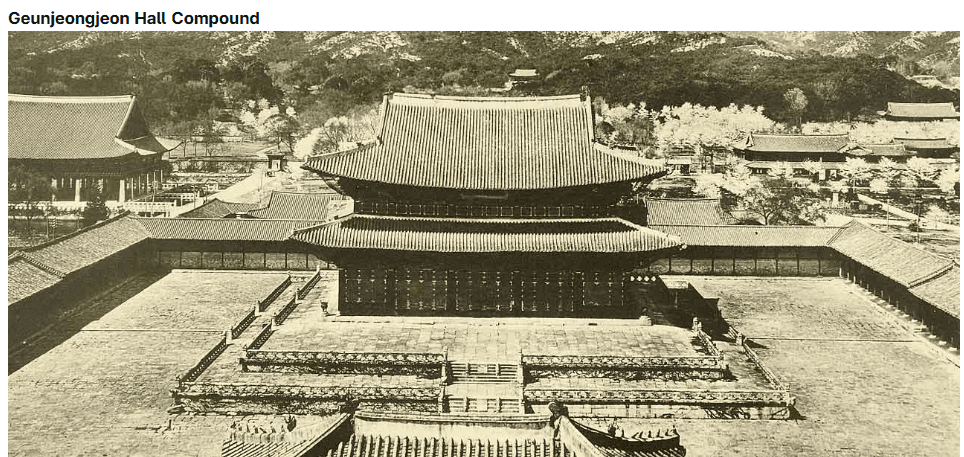
Gyeongbokgung , Can you imagine a traditional Korean palace, with its vibrant “Dancheong” colors and curved tiled roofs, standing right next to the Eiffel Tower?
It’s not a scene from a fantasy movie. In 1900, during the height of the Belle Époque, the “Hermit Kingdom” of Korea made a grand, unexpected entrance onto the world stage at the Paris Exposition Universelle.
1. Why Did a Tiny Kingdom Travel Halfway Around the World?
At the turn of the 20th century, the Korean Empire (Empire de Corée) was at a critical crossroads. Surrounded by powerful neighbors, Emperor Gojong decided to use the 1900 Paris Expo as a “diplomatic stage” to shout one message to the world: “We are a sovereign, independent, and culturally rich nation.”
Instead of being a small corner in another country’s booth, Korea built its own independent pavilion—a stunning replica of the Geunjeongjeon Hall from Gyeongbokgung Palace. For the first time, the world saw the name “COREA” not as a colony, but as an empire.
Looking for
Korean Favorites?
As an Amazon Associate, I earn from qualifying purchases.
2. Captivating Parisians: The “Instagrammable” Pavilion of 1900
Long before social media, the Korean Pavilion was a viral sensation.
- Architectural Wonder: While Paris was filled with stone and steel, the wooden Korean pavilion stood out with its “flying” eaves and mystical roof guardians (Japsang).
- The First K-PR Strategy: Korea distributed 48 types of photo postcards showing its landscapes and people. It was the first-ever global branding campaign for Korean culture.
3. Beyond Just Kimchi: What Did They Show?
Korea didn’t just bring food; they brought high-tech and high-art of the era. The results were shocking to the Western world, which at the time knew little about the peninsula.
| Category | Highlighted Item | The “Wow” Factor |
| Art & Tech | Jikji (Metal Type Book) | Proved Korea had the world’s oldest movable metal type technology. |
| Crafts | Mother-of-pearl & Lacquerware | Parisians were mesmerized by the “mystical iridescent glow.” |
| Luxury | Silk Hanbok & Embroidery | Described as “the most elegant attire in the Orient.” |
| Health | Korean Ginseng | Won the Grand Prix (Top Prize) for its incredible quality. |
By the end of the Expo, Korea walked away with 21 awards, including 1 Grand Prix and 2 Gold Medals. The “Hermit Kingdom” had successfully rebranded itself as a “Cultural Powerhouse.”
4. Why This Story Matters Today
This “grand outing” in 1900 was a bittersweet moment. Shortly after, Korea faced a dark period of colonization. However, the seeds of pride sown in Paris never died.
The spirit that led Korea to rebuild a palace in the heart of Paris is the same spirit behind today’s Hallyu (Korean Wave). From the 1900 Paris Expo to the global success of BTS and K-dramas, Korea’s desire to connect with and inspire the world remains unchanged.
[Key Takeaway]
The 1900 Paris Expo was the first moment modern Korea dared to dream big on a global stage, proving that culture is the strongest form of diplomacy.
Writer’s Note:
Next time you visit the Eiffel Tower, try to imagine the sound of a Gayageum (Korean zither) echoing across the Seine. History is closer than we think!
What part of Korean history surprises you the most? Let’s talk in the comments!
❓ FAQ for Travelers & History Buffs
Q1. Where is the pavilion now?
A. Sadly, the wooden structure was dismantled after the Expo. However, many of the items displayed are still preserved in French museums like the Musée Guimet and the National Library of France (BnF).
Q2. Was ‘Jikji’ really there?
A. Yes! The world’s oldest movable metal type book was a star attraction. It is still held at the BnF in Paris today, serving as a bridge between Korean and French history.
Q3. How can I see this history today?
A. You can visit Gyeongbokgung Palace in Seoul to see the original Geunjeongjeon Hall that inspired the Paris pavilion, or explore the “Korean Empire” section at the National Museum of Korea.